
Content overseen by: David Van de Borne · Updated on 27 November 2026
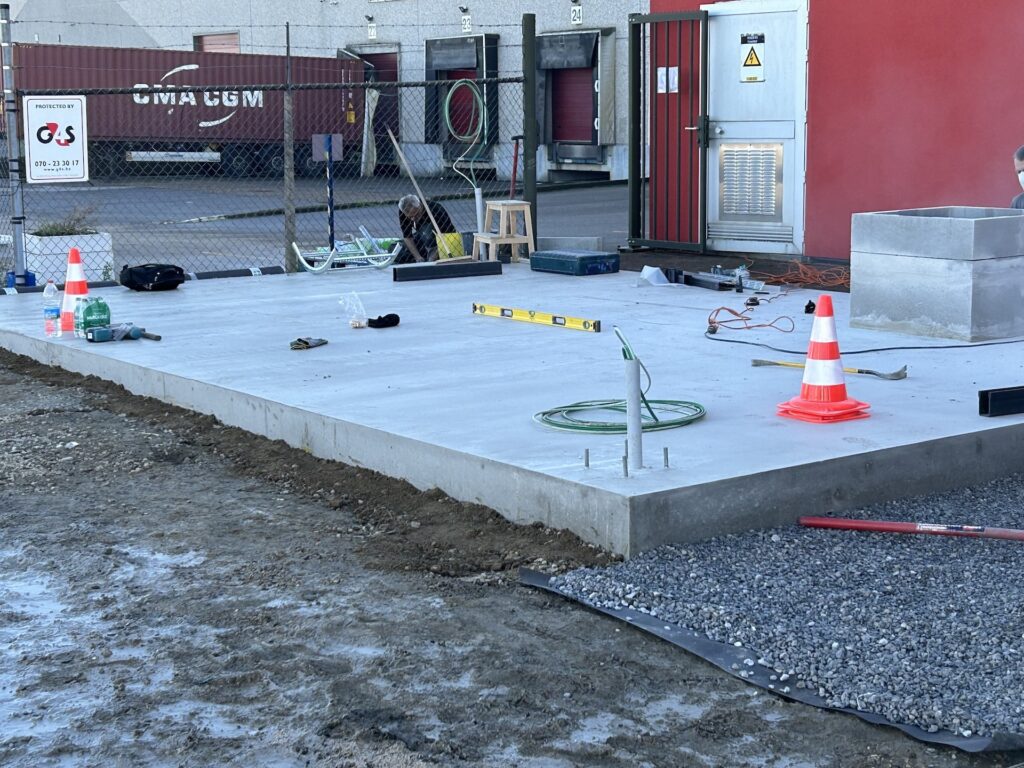
1. Start with the generator’s technical specifications
First, ask the generator supplier or engineering consultancy to provide the information that determines the installation area: weight, support points, operating loads, anchoring and required clearances. The positions of cable entries and any vibration control provisions must also be known. Without this information, a concrete plinth may fit beneath the enclosure yet still be unsuitable for the installation.
The dimensions, reinforcement and construction of the foundation depend on these specifications and the ground conditions. For concrete works for a generator installation, penetrations, recesses and cast-in provisions must also be defined in advance. Coordinate the plinth height with the finished ground level and drainage so that these elements are not designed in isolation.
2. Plan site preparation and drainage together
Preparation may involve removing existing paving, excavation, modifying the subgrade and reinstating the site. Map existing pipes and cables in advance and check where new trenches can run. Consider not only the final installation area but also the route used to deliver and position the generator.
When preparing drainage, assess how water may collect and be discharged around the plinth, cable entries and access route. The solution depends on site gradients, existing drainage outlets and the planned paving. By planning earthworks and drainage together, you can incorporate trenches, drainage pipes and site reinstatement into a coordinated sequence of works.
3. Define cable routes and connection points in advance
Determine the start and end points of power, control and communication cables with the technical parties involved. The route must account for distance, crossings, mechanical protection, accessible connection points and building penetrations. The electrical designer determines cable selection and the connection method based on the installation specifications. An available trench is therefore not automatically a suitable cable route.
For electrical works around the generator, the scope of power connections, earthing and any links to changeover or control equipment must be clearly defined. Agree on who will make each connection and who will check how everything works together. Provide penetrations before pouring the concrete, and adapt their construction to moisture exposure and cable protection requirements. This reduces the need to reopen a finished plinth or wall.
4. Combine restricted access with practical accessibility
Fencing can restrict access to the generator area but must not obstruct maintenance, air intake or the discharge of warm air. Ask the generator supplier to specify the required clearances before planning posts, walls or gates. Also account for doors and panels that must be able to open fully during maintenance.
When designing fencing around technical installations, give separate consideration to the gate position, maintenance access route and accessibility for future replacement. A generator installed before the fencing is erected must remain accessible afterwards. Coordinate post foundations with underground cables and drainage pipes, and do not position fencing across areas needed for maintenance or repair work.
5. Clearly allocate responsibilities before work begins
Bring the approved layout, foundation specifications, cable routes, connection points and site levels together in a single construction file. Then establish the sequence: preparation, trenches and underground provisions, foundation, generator placement, connections and site reinstatement. Before closing up, check that penetrations and service lines match the agreed plan. Record any deviations as well, so that the final locations can be traced.
DCO Construction has been active since 1980 and serves businesses throughout Belgium from Fabrieksstraat 108, 1930 Zaventem. For generator infrastructure, the company combines building and electrical works, including foundations, walls, posts, cabling, connections and fencing. The generator itself is not included in the supply. You should therefore explicitly define which information and tasks are the responsibility of the generator supplier, the engineering consultancy and DCO Construction.
Frequently asked questions
More answers about preparing and carrying out your project.
Can a generator stand on an existing concrete slab?
This can only be assessed once the slab and ground conditions have been checked against the generator’s loads and support points. Have the condition, anchoring and available penetrations assessed as well. A slab that appears intact does not, on its own, provide enough information.
Which generator specifications are needed for infrastructure works?
Provide the installation layout, the generator’s technical specifications, available site plans and the required connection points. Also identify existing paving, underground services and access restrictions. Any missing design information must first be clarified with the supplier or engineering consultancy.
Should the cable route be as short as possible?
Length matters, but it is not the only criterion. A short route may involve unsuitable crossings, hard-to-reach penetrations or conflicts with foundations. The route must be electrically suitable, practical to construct and accessible for future work.
Who positions and starts up the generator?
Agree separately on who will handle transport, unloading, positioning and start-up. Infrastructure works do not automatically include these tasks. DCO Construction does not supply generators; connection and handover must be coordinated with the party supplying and starting up the unit.
Content overseen by
David Van de Borne
Director of DCO Construction, the family business active in construction, finishing and technical works since 1980. The articles focus on the practical delivery of business projects.
Discuss your electrical infrastructure